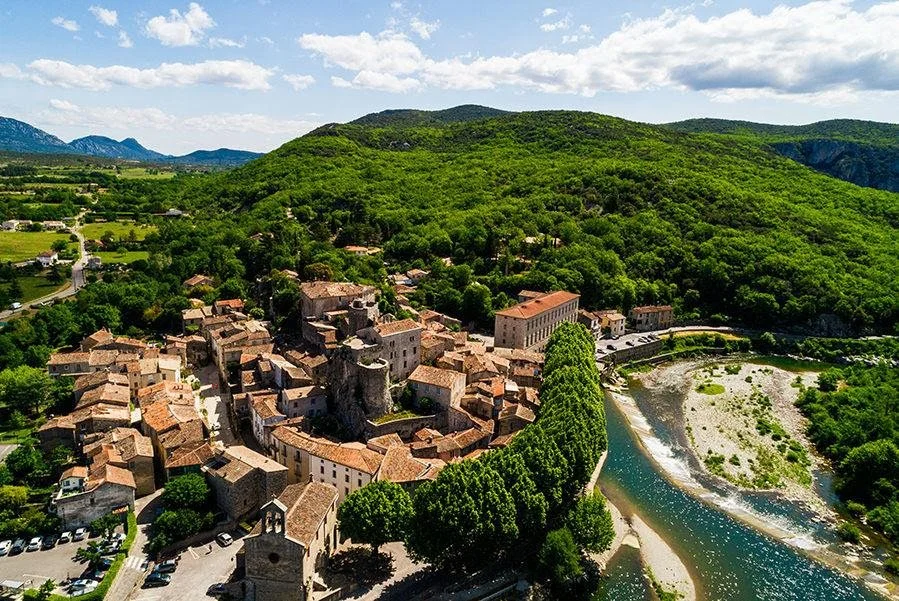
La Maison des Dames
L'un des édifices historiques les plus anciens et les plus importants du village médiéval de Laroque, dans le département de l'Hérault, en région des Cévennes dans le sud de la France, est connu sous le nom de Maison des Dames. Les bâtiments de ce type étaient souvent associés aux élites locales — qu'elles soient nobles, ecclésiastiques ou issues de riches familles marchandes — cependant, le terme Maison des Dames tire son origine de la possession du lieu par des chanoinesses, d'un lien avec des femmes de la noblesse, puis de son usage ultérieur en tant que communauté religieuse féminine (les Dames).
Les documents d'archives rattachent cet édifice médiéval au développement du village à ses débuts, au cours du Moyen Âge, et plus précisément : « …une remarquable rangée de maisons romanes du XIIe siècle (…) ces maisons accueillaient les Dames Servantes du Seigneur. » L'occupation de cette demeure, et son profond ancrage historique dans l'histoire seigneuriale et religieuse locale de la vallée du Ganges, est inextricablement liée à la complexe histoire religieuse des Cévennes et du Languedoc.
Histoire Médiévale
Sur le plan architectural, ce bâtiment témoigne de la prospérité de Laroque au Moyen Âge, à travers sa construction en blocs de pierre taillés à la main et ses caractéristiques médiévales, notamment une meurtrière de fortification intérieure du IXe siècle (ouverture verticale en embrasure, créneau de tir ou archère) au sein du 6 rue du Château, de grandes caves voûtées, ainsi que de remarquables exemples de maçonnerie en arc de pierre à encorbellement, également au 6 rue du Château.
Il convient de souligner que cet édifice a également servi à l'origine de premier prolongement des remparts défensifs, construit pour assurer la surveillance de trois points d'accès importants et protéger les occupants du Château de Laroque, de sa sacristie et de la Chapelle — le plus ancien noyau historique de Laroque. Le réseau de ruelles fut ensuite développé avec l'avènement des égouts, de l'adduction d'eau, puis des réseaux électriques au XXe siècle.
Architecture Romane
Ce vaste édifice aux multiples facettes renferme plusieurs caves reliées entre elles, un portail roman à arc en plein cintre avec un tympan construit selon le Nombre d'Or (la proportion harmonieuse entre largeur et hauteur — un mètre de large pour 1,618 mètre de haut), et une fenêtre romane géminée (bifora) sous l'imposante ligne de toiture, ornée d'une sculpture archaïque en creux. Une coquille Saint-Jacques est sculptée dans le linteau cintré du portail, indiquant aux pèlerins en route vers Saint-Jacques-de-Compostelle où ils pouvaient trouver nourriture et hébergement.
Depuis les deux niveaux supérieurs de ce bâtiment (accessibles par la rue du Château), une vue remarquable sur le fleuve Hérault s'offre à travers une fenêtre géminée, dont la colonne centrale est surmontée de quatre petites figurines du XIIIe siècle dont le style rappelle celui des anciennes Cyclades grecques, représentant les quatre points cardinaux. Au rez-de-chaussée (accessible par la rue de la Madeleine), plusieurs anciens portails romans ouvrent sur des caves reliées entre elles, dont l'un présente une clé de voûte décalée — caractéristique architecturale rare — ainsi qu'un arc de décharge formé de deux pierres triangulaires, technique de construction héritée de l'architecture grecque antique et antérieure aux portails romans.
La Roque (« Le Rocher »)
Le nom de Laroque est issu de la roque (« le rocher »), en référence à l'affleurement calcaire qui domine la vallée de l'Hérault. Le village s'est développé de manière stratégique au fil des siècles, et à travers de nombreuses guerres de religion, en tant que site fortifié contrôlant le passage dans la vallée, la traversée de la rivière et les voies commerciales menant vers les Cévennes méridionales. Ce village médiéval au tissu serré est construit sur d'immenses cavernes de pierre massive et des passages voûtés, édifiés dans et autour du pied de la falaise. Historiquement, il a également servi de lieu d'incarcération — une place forte aux ruelles étroites, aux passages voûtés et aux structures défensives médiévales.
Village Médiéval Fortifié
Le Château de Laroque (Hérault) est un site fortifié datant des XIe et XIIe siècles, aujourd'hui classé monument historique en France. Depuis son origine, bien avant qu'une tour de guet n'y soit érigée, ce site a servi de poste d'observation pour surveiller, contrôler et suivre les déplacements humains et animaux dans la vallée de l'Hérault.
Attenant au Château de Laroque, le donjon pentagonal fortifié s'élevait à près de 36 mètres de hauteur avant d'être tronqué sur ordre de Richelieu, à la suite des guerres de Rohan du début et de la fin du XVIIe siècle. Il abrite à son sommet une cloche qui sonne toutes les heures et lors des moments de grande détresse, offerte en 1630 par Bertrand de Saussan, co-seigneur de Laroque. La chapelle du château, consacrée en 1152, fut agrandie au XIVe siècle par l'adjonction d'un avant-cour et d'une cour intérieure. Sa sacristie fut installée dans une ancienne tour de guet militaire, visible de l'extérieur à l'angle du mur du donjon et reconnaissable à ses mâchicoulis.
La résidence seigneuriale, légèrement en retrait des autres bâtiments, est une imposante construction remaniée au XVIe siècle pour intégrer des arcades, des jardins et une cour abritant l'ancien baptistère en pierre de la chapelle du château. Les armoiries de la famille La Roque, co-seigneurs de Laroque, sont sculptées dans la pierre et figurent en plusieurs endroits du site.
Prospérité Médiévale
Depuis sa fondation — bien avant le commerce agricole et la production textile industrialisée qui lui succéda — et en dépit de sa fortification au tissu resserré, Laroque a constitué pour chaque occupant successif un bastion modeste mais chargé d'une forte signification politique, nonobstant les guerres de religion qui, dans certains cas, durèrent plusieurs siècles.
Le développement successif de quartiers commerçants, d'installations industrielles et de services régionaux sur les plaines inondables et les terres basses a entraîné le déclin des commerces traditionnels dans le village historique, tels que la boulangerie, la boucherie et l'épicerie.
Références et informations complémentaires
Petites Cités de Caractère - https://www.petitescitesdecaractere.com/wp-content/uploads/2025/10/parcours-decouverte-du-patrimoine-laroque-34.pdf
The Maison des Dames
The front entrance at 6 Rue du Château, Laroque - 6 May 2026 - photo by Alexander Hayes
One of the oldest and most significant historic buildings in the medieval village of Laroque, in the Hérault Department of the Cévennes region of southern France, is known as the Maison des Dames ("House of the Ladies"). Buildings of this type were often associated with local elites — whether noble, ecclesiastical, or wealthy merchant families — however, the term Maison des Dames derives from ownership by canonesses, a connection with noblewomen, and later from its use as a female religious community ("les Dames").
Documentary evidence links this medieval building to the village's early development during the Middle Ages, specifically: "…a remarkable row of 12th-century Romanesque houses (…) these houses accommodated the Ladies Servants of the Lord." The occupancy of this dwelling, and its deep historical association with the local seigneurial and religious history of the Ganges valley, is inextricably woven into the complex religious history of the greater Cévennes and Languedoc.
Medieval History
Architecturally, this building reflects the prosperity of medieval Laroque through its hand-hewn stone block construction and medieval features, including an internal 9th-century fortification meurtrière (a vertical aperture embrasure, loophole, or arrowslit) within 6 Rue du Château, large vaulted cellars, and intricate examples of recessed stone archway masonry, also within 6 Rue du Château.
Of notable significance is the fact that this building originally served as one of the first extensions of the defensive ramparts, constructed to ensure surveillance of three significant street (rue) access points and to protect those within the Château de Laroque, its sacristy, and the Chapel — the oldest historic core of Laroque. The network of streets was further developed with the advent of piped sewerage, water supplies, and later electrical services in the 20th century.
Romanesque Architecture
This large, multifaceted building contains multiple interlinked cellars, a Romanesque semicircular-arched doorway with a tympanum built according to the Golden Ratio (the harmonious proportion between width and height — one metre wide, 1.618 metres high), and a paired Romanesque window (bifora) beneath the towering roofline, featuring a recessed archaic carving. A scallop shell of Saint James is carved into the curved lintel of the doorway, indicating to pilgrims travelling to Santiago de Compostela where they could find food and lodging.
From the upper two levels of this building (accessed via Rue du Château), there is a commanding view of the Hérault River through a paired window, its central column topped with four small 13th-century figurines whose style recalls that of the ancient Greek Cycladic tradition, representing the four cardinal directions. On the ground floor (accessed via Rue de la Madeleine), multiple ancient Romanesque doorways lead to interlinked cellars, including one with an offset keystone — a rare architectural feature — as well as a relieving arch formed by two triangular stones, a construction technique inherited from ancient Greek architecture and predating Romanesque doorways.
La Roque ("The Rock")
Laroque's name derives from la roque ("the rock"), referring to the limestone outcrop that dominates the valley of the Hérault River. The village was developed strategically over centuries, and through many religious wars, as a fortified site controlling passage through the valley, the river crossing, and trade routes leading towards the southern Cévennes. This tightly clustered medieval village is constructed upon immense solid stone caverns and vaulted passageways, built into and around the base of the cliff. Historically, it also served as a place of incarceration — a fortified settlement of narrow streets, vaulted passages, and medieval defensive structures.
Fortified Medieval Village
Château de Laroque (Hérault) is a fortified site dating from the 11th and 12th centuries, now listed as a historical monument in France. From its inception, long before any watchtower was built, this site has served as a vantage point to safeguard, control, and monitor human and animal movement through the Hérault Valley.
Adjacent to the Château de Laroque, the fortified pentagonal keep stood nearly 36 metres high until it was truncated on the orders of Richelieu, following the Rohan Wars of the early and later 17th century. It houses a bell at its summit, which rings every hour and in times of significant distress, donated by Bertrand de Saussan, co-lord of Laroque, in 1630. The castle chapel, consecrated in 1152, was enlarged in the 14th century with the addition of a forecourt and courtyard. Its sacristy was installed in a former military watchtower, visible from the exterior at the corner of the keep's wall and recognisable by its machicolations.
The lord's residence, set slightly back from the other buildings, is an imposing structure remodelled in the 16th century to include arcades, gardens, and a courtyard that houses the old stone baptismal font from the castle chapel. The coat of arms of the La Roque family, co-lords of Laroque, is carved in stone and appears throughout the site.
Medieval Prosperity
Since its foundation — long before agricultural trade and later industrialised textile production — and despite its tightly clustered fortification, Laroque has served as a small but politically significant stronghold for each successive occupier, notwithstanding the religious wars that in some cases endured for centuries.
The successive development of retail precincts, industrial facilities, and regional services on the floodplains and lowlands has led to the decline of traditional establishments within the historic village, such as the former boulangerie (bakery), boucherie (butcher), and épicerie (grocery).
References & Further Information
Petites Cités de Charactère - https://www.petitescitesdecaractere.com/wp-content/uploads/2025/10/parcours-decouverte-du-patrimoine-laroque-34.pdf